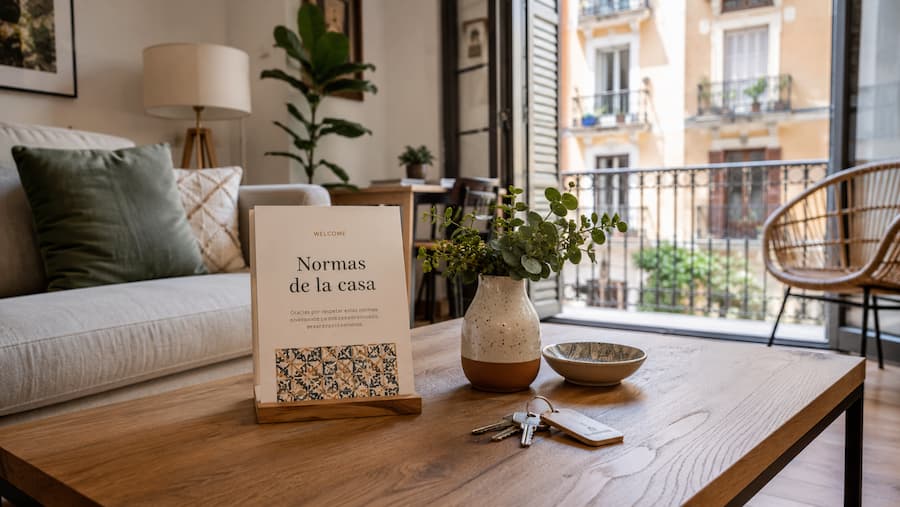

A few Clear house rules They protect the property, reduce incidents with guests, and help maintain good neighborly relations. In a vacation rental, it's not about imposing rigid rules, but about anticipating questions, explaining reasonable boundaries, and facilitating a comfortable stay for all parties involved.
For owners of tourist apartments in Barcelona, this point is especially important: guest turnover, neighborhood communities, and local regulations mean that every detail counts. At BCN Flat Management, we usually work these rules as part of a Preventive management, because a well-written instruction can prevent many calls, complaints, and subsequent costs.
Why you need house rules for your vacation rental
The House rules for a vacation rental they function as a framework for coexistence. The guest knows what they can do, what is not allowed, and how to act in common situations: arrival, departure, trash, noise, keys, use of appliances, or possible damage.
Furthermore, these rules help filter expectations before booking. A property that transparently explains its conditions conveys professionalism and avoids misunderstandings. It's not the same to say “take care of the apartment” as to indicate how the air conditioning should be used, where to throw the trash, or what quiet hours should be respected.
Before writing them, it's important to have a clear idea: the rules should be Concrete, kind, and applicable. If they are too long, the guest won't read them; if they are ambiguous, they won't help resolve conflicts. The balance lies in explaining the essentials with a firm, but hospitable tone.
In the daily management of tourist apartments, especially in a high-demand city like Barcelona, it's advisable to review these rules frequently. Changes in the community, new recurring incidents, or operational adjustments may necessitate updating the document.
1. Check-in and check-out times
The first rule must clarify the Check-in and check-out times. It seems basic, but it's one of the most common sources of incidents: guests arriving early, late check-outs delaying cleaning, or poorly coordinated key handovers.
It is recommended to indicate the exact check-in time, the check-out time limit, and what happens if the guest needs an exception. It is also advisable to explain whether check-in is in person, autonomous, or through some digital access system.
A useful formulation can include these points:
- Official entry and exit times.
- Procedure for Key Handover or Return.
- Off-hours arrival conditions.
- Possible charges for unauthorized late checkout.
At BCN Flat Management, we place great importance on this part because precise coordination allows for Apartment cleaning, Apartment maintenance and reception work without improvisations. For the guest, moreover, an orderly arrival sets the tone for the entire stay.
2. Maximum number of guests and visitors
The accommodation capacity must be clearly defined. This standard prevents overcrowding, nuisance to neighbors, and potential security or regulatory compliance issues.
It's not enough to state how many people can sleep in the apartment. It's also recommended to clarify if day visitors are allowed, if they need to be communicated in advance, and if unregistered individuals are prohibited from staying overnight in the dwelling.
This rule especially protects owners from spontaneous parties, fraudulent bookings, or more intensive use of the apartment than intended. In urban tourist accommodations, where many properties are in residential buildings, controlling occupancy is key to maintaining good neighborly relations.
The wording should be direct: the accommodation can only be used by the people included in the reservation, and any additional visitors require prior authorization. This way, the guest understands the limitation without feeling mistrusted.
3. Respect for rest and prohibition of parties
Noise is one of the most sensitive points in any vacation rental. That's why the rules must clearly include the Respect for rest hours, the prohibition of parties and the obligation to avoid loud music, shouting, or gatherings that may disturb the community.
In Barcelona, many tourist apartments coexist with regular residents. Therefore, a good set of rules not only protects the owner but also the reputation of the accommodation and the relationship with the community of neighbors.
For this rule to be effective, it is advisable to indicate:
- Quiet hours or night rest.
- Express prohibition of parties and events.
- Respectful use of common areas, stairs, and elevator.
- Consequences of repeated complaints or external intervention.
After explaining it, it's helpful to add a kind sentence: “We want you to enjoy your stay, but we also want the neighbors to be able to rest.” That nuance changes the tone and turns a prohibition into a Code of conduct.
4. Responsible Use of Appliances, HVAC, and Utilities
Guests may not always be familiar with how appliances, heating, air conditioning, or hot water systems work. Including clear instructions reduces malfunctions, excessive consumption, and unnecessary calls during their stay.
This standard should explain how to use the main equipment and what actions to avoid. For example, do not leave the air conditioning on with the windows open, do not tamper with the boiler, do not put inappropriate objects in the dishwasher, or do not overload the electrical system.
In our case, when managing tourist apartments, we usually recommend that the instructions be both in the rules document and in a visible place within the property. A guest tired after a trip appreciates a simple and accessible explanation.
It's also a good idea to connect this rule with energy saving. There's no need for a speech: just ask people to turn off lights and air conditioning when they leave. It's a practical, sustainable, and easy-to-follow guideline.
5. Cleaning, Trash, and Recycling
The final cleaning is typically handled by professional staff, but guests should be aware of what is expected of them before departure. This rule prevents apartments from being left in poor condition, with bad odors, accumulated waste, or issues with the community.
The Cleaning standards They should be reasonable. Asking guests to tidy up the apartment, take out the trash, and avoid accumulating food scraps makes sense. Requiring them to perform tasks typically done by a cleaning service can lead to frustration and bad reviews.
Before listing instructions, it's advisable to adapt the rule to the municipality and the building. In Barcelona, for example, there may be separate bins, specific schedules, or community rules that affect the use of common areas.
- Indicate where the containers are located.
- Explain how to separate waste and recycling.
- Do not leave trash in hallways or landings.
- Clarify what to do with used furnishings before check-out.
A well-formulated standard improves the experience for the next guest and facilitates operational work. In professional management, these small habits have a direct impact on time, costs, and ratings.
6. Home Security
Safety regulations should explain how to protect the home and the guests themselves. This includes issues like locking doors and windows when leaving, not leaving keys in the lock on the inside, locating fire extinguishers, or knowing who to call in case of an emergency.
The key is that this section be Useful and easy to follow. If the apartment has detectors, an alarm, a safe, a first-aid kit, or specific instructions for children, this must be clearly indicated.
It is also advisable to include guidelines for balconies, terraces, and windows, especially on higher floors. In urban tourist apartments, the reckless use of these spaces can become a serious risk and should be expressly limited.
From BCN Flat Management We recommend that safety regulations not be hidden at the end of the document. They should be present in prior communication and, if necessary, reinforced in the housing with discreet and well-designed signage.
7. Damages, defects, and incident reporting
Accidents happen. A broken glass or a jammed blind shouldn't automatically become a conflict, but the guest must know that any damage should be communicated as soon as possible.
This standard helps to act quickly, assess the impact, and prepare the property for the next booking. The problem is usually not the damage itself, but discovering it late, with no room to repair it or claim it properly.
The wording should avoid an accusatory tone. It's better to explain that uncommunicated damages, negligent use, or improper handling of facilities may incur additional charges. This conveys responsibility without breaking the trust relationship.
When working with a company Tourist housing management, This point is integrated into a broader protocol: post-departure review, maintenance coordination, and incident documentation.
8. Rules Regarding Tobacco, Pets, and Odors
Rules regarding tobacco, pets, and odors must be defined before booking. These are topics that directly affect the condition of the apartment, subsequent cleaning, and the experience of the next guest.
If smoking is not allowed, it must be explicitly stated. The same applies if it is only permitted on the terrace or balcony. The same goes for pets: accepting them can broaden the potential audience, but requires clear conditions regarding cleanliness, restricted areas, noise, and responsibility for damages.
In this section, it's also advisable to include the use of candles, incense, or products that might leave persistent odors. It may seem like a minor detail, but in short stays, any strong smell can affect the next guest.
A good rule does not judge the guest; it simply establishes the conditions for using the property. The clearer it is from the beginning, the less room there will be for claims or misunderstandings.
9. Use of common areas, terrace, balcony, or parking
If the home has a terrace, balcony, pool, garden, parking, or access to common areas, each space needs specific rules. Not all rules need to be long, but they should cover uses that could generate risks, disturbances, or conflicts.
In residential buildings, common areas are one of the most sensitive points. Guests must be aware that they cannot occupy spaces that do not belong to their dwelling, leave objects in the landing, make noise on the stairs, or use facilities outside of permitted hours.
When parking is available, the rules should specify the parking spot number, access, maximum height if applicable, and a prohibition against occupying others' spots. If there is a terrace or balcony, it's advisable to clarify usage hours, noise limits, and prohibitions related to risks.
At BCN Flat Management, we adapt these guidelines to each property, because a centrally located apartment in a residential building doesn't have the same needs as a home with a private terrace or a building entirely dedicated to tourist accommodation.
10. Contact, Emergencies, and Consequences of Non-Compliance
The guest should know who to turn to if something happens. This rule must include the Support contact, emergency phones and the correct way to report incidents during your stay.
It is also important to explain what happens if house rules are broken: charges for damages, penalties for late checkout, intervention for parties, communication with the booking platform, or termination of the stay in serious cases. You don't need to go into too much detail, but make it clear that the rules are binding.
Before closing the document, it's worth reinforcing a positive idea: the rules exist to ensure a safe, comfortable, and respectful stay. Guests should not perceive them as a list of prohibitions, but rather as a simple guide to enjoy the accommodation without any issues.
The best version of house rules for a vacation rental is one that combines clarity, a human tone, and operational consistency. When well-written, they help the owner, guide the guest, and facilitate professional property management from start to finish.
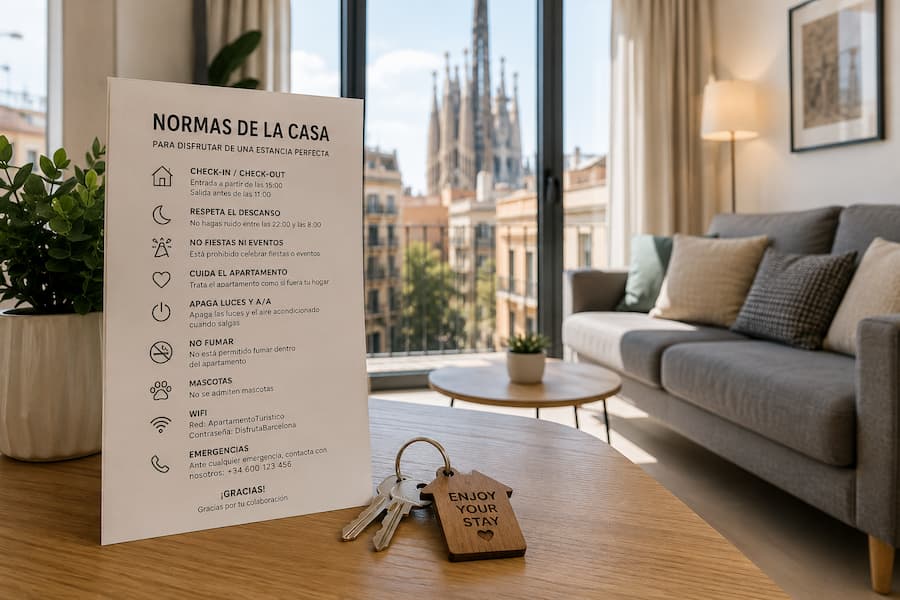
How to present the rules for guests to read
It's not enough to have good rules: you also have to communicate them well. Ideally, guests should receive them before arrival, be able to consult them during their stay, and find a summarized version of the most important points within the apartment.
The format should be visual, brief, and easy to scan. An endless document, written in a legalistic tone, usually has less impact than a well-structured guide with clear sections and direct sentences.
A practical strategy is to divide communication into three moments:
- Before booking or confirmation: key conditions such as capacity, parties, pets, and smoking.
- Before arrival: check-in, access, hours, and contact.
- During your stay: visible summary with Wi-Fi, trash, emergencies, and essential rules.
This approach reduces repetitive doubts and improves the perception of the accommodation. In practice, clear communication also influences reviews, because the guest feels that everything is organized and that they can resolve any doubts effortlessly.
House rules for a tourist apartment: 1. **Quiet Hours:** Please observe quiet hours from 10 PM to 8 AM. No loud music or parties. 2. **No Smoking:** The apartment is strictly non-smoking. Please use designated outdoor areas if you smoke. 3. **Pets:** Pets are not allowed. 4. **Trash Disposal:** Please tie up all trash bags and dispose of them in the designated bins outside. 5. **Cleaning:** Please wash dishes and put them away before check-out. Leave the apartment tidy. 6. **Check-out Time:** Check-out is at 11 AM. Please ensure all personal belongings are removed. 7. **Damages:** Any damages to the property or its contents must be reported immediately. 8. **Keys:** Please return all keys upon check-out. 9. **Respect Neighbors:** Be considerate of other residents in the building. 10. **Enjoy Your Stay!** We hope you have a pleasant and relaxing visit.
An effective model doesn't need to be complicated. It should capture the essential points and adapt to the reality of each home. Below is a guideline example that can serve as a basis for customizing your own rules.
Remember that each apartment has unique characteristics: community, layout, equipment, license, type of guest, and location. Therefore, this example should be reviewed before being used as a final document.
Welcome to the apartment. To ensure a pleasant and respectful stay, we ask that you comply with these basic rules: respect the rest of the neighbors, do not hold parties, do not exceed the number of guests indicated in the reservation, take care of the equipment, turn off lights and air conditioning when leaving, throw trash in the corresponding bins, do not smoke inside the home, and report any incidents as soon as possible. Checkout must be done before the agreed time and the keys must be left according to the instructions provided.
This type of text can be supplemented with specific instructions about appliances, the terrace, parking, pets, or emergencies. The key is for the guest to find a clear guide, not a confusing document.
What mistakes to avoid when writing rules
One of the most common mistakes is to write overly generic rules. Phrases like “be respectful” or “take care of the house” are positive, but they don't explain what specific behavior is expected of the guest.
Another common mistake is using an overly harsh tone. Rules should protect the owner, but they are also part of the hospitality experience. Aggressive language can lead to rejection even before arrival.
For the document to work, avoid these problems:
- Include rules that you cannot control or enforce later.
- Writing paragraphs that are too long or ambiguous.
- Forget the rules of the homeowners' association.
- Do not update the document after repeated incidents.
- Do not translate the rules if you receive international guests.
The ultimate goal is for the rules to be understandable and useful. In a well-managed vacation rental, each rule should address a real need: protecting the property, avoiding conflicts, improving the stay, or facilitating daily operations.
When regulations are well-thought-out, they cease to be a mere formality and become a management tool. For tourist apartment owners in Barcelona, having a professional system to review, communicate, and enforce these rules can make the difference between a property that generates problems and a property that operates with stability.